
Restoration Pathways
Three pathways to carbon removal.
Each pathway is selected for its scientific rigour, carbon permanence, measurability, and co-benefits for soil, water, biodiversity, and rural communities across India.
Pathway Selection Criteria
Every Prithvi CDR pathway must satisfy four criteria before deployment: additionality (the removal would not occur without intervention), permanence (carbon stays removed for the claimed duration), measurability (tonnes can be quantified using verified methods), and co-benefits (the project generates positive ecological or livelihood outcomes beyond carbon).
Biochar
Carbon, returned to soil.
Biochar is produced by heating organic material in low-oxygen conditions through a process called pyrolysis. The resulting carbon is highly stable, resistant to microbial decomposition for centuries to millennia. Applied to agricultural land, it improves water retention, soil nutrient cycling, and microbial health while locking carbon out of the atmosphere for the long term.
Enhanced Rock Weathering
Accelerating a geological carbon sink.
Enhanced Rock Weathering (ERW) spreads finely crushed silicate rock (typically basalt) across agricultural land. As the rock weathers, it reacts with atmospheric CO₂ and water to form stable bicarbonate minerals that are carried to the ocean and stored on geological timescales. The same process has regulated atmospheric carbon for millions of years. ERW accelerates it at human-relevant scales.
Afforestation
Returning tree cover to degraded land.
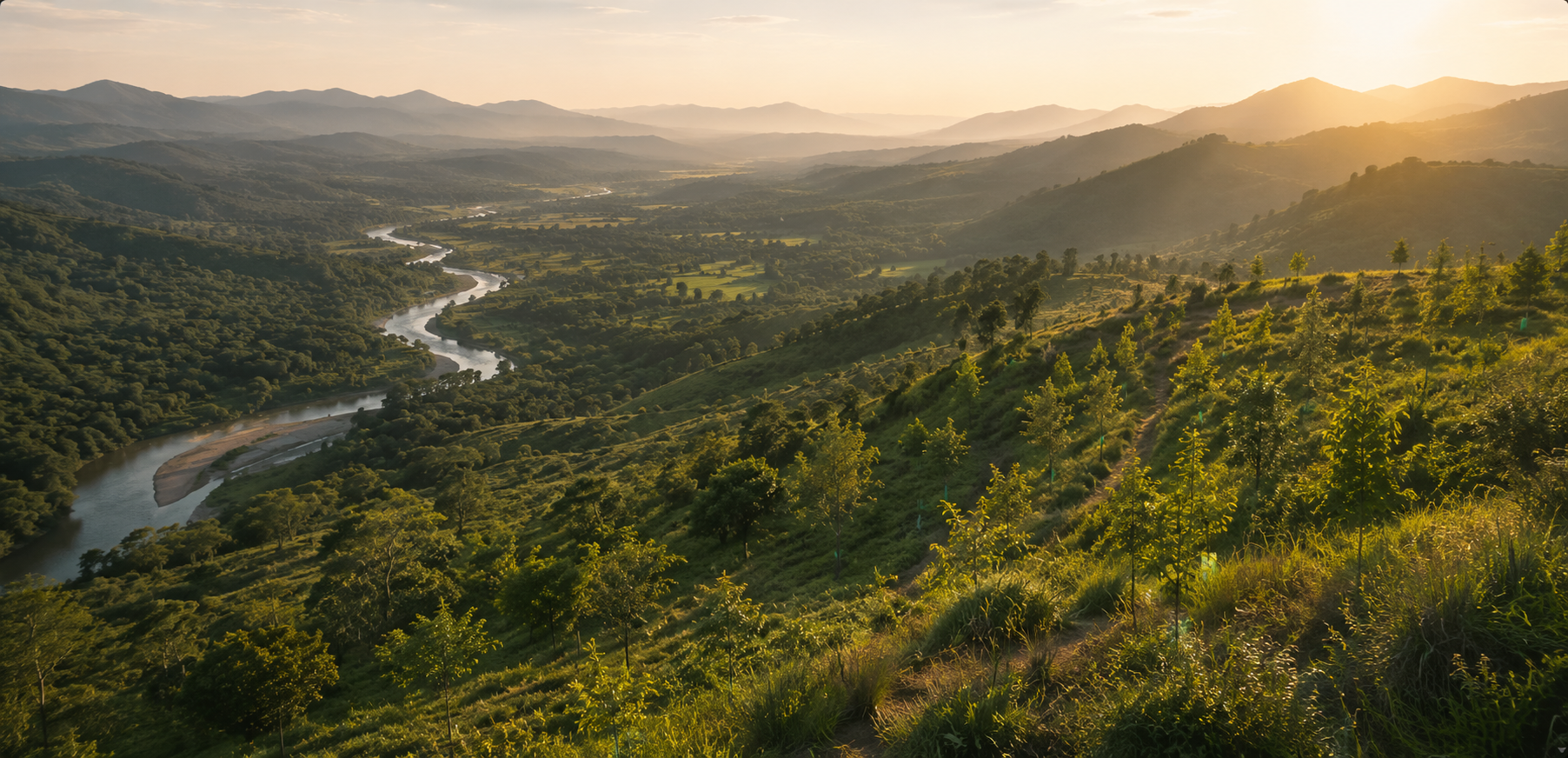
Afforestation establishes new forest on land that has been without tree cover, sequestering carbon in growing biomass and rebuilding soil organic matter over time. Prithvi CDR uses native species matched to local ecological conditions, with multi-species planting that rebuilds habitat function alongside carbon stocks. Projects are sited on demonstrably degraded land with clear additionality.